
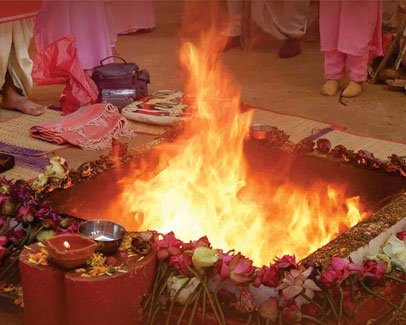
 Agni (the fire), one of the Gods in Rigveda, receives the ‘haviss’ (melted ghee) for other Gods. ‘Yajna’ or Yaga is a Karma performed based on Vedas and ‘Srouthasasthras’ (sciences based on Veda). Yaga is performed to make the subtle forces in the universe advantageous to mankind and for the development of body, mind and wisdom. The fire which always aims the heaven (flames upwards) is a messenger who carries the materials which are submitted in it. The word ‘Yajikkuka’ means venerate or do the Karma related to the Veda. The person who does the Yaga is known as ‘Yajnakrith’ and the person for whom it is performed is known as ‘Yajamana’. Vishnu is the worshipped God in all Yagas and Agni (the fire) is the ‘Yajnamurthi’. The material which is fired is known as ‘Dravya’ and for whom it is done is known as ‘Devatha’.
The greatness of Yaga has always been realized by the ‘Homagni’ (offering fire) rose from the premises of Yagasala (the makeshift shed built for the Yaga). We have heard several times that the wings of a great tradition fluttering above the Indian land when ‘athirathragni’ (the fire of athirathra homa) rose to the sky from Garuda homathara, when haviss submitted to the fire, when the Yagasala was eaten completely by the Agni and finally when the rain clouds appeared and showered heavily. We have seen many Western scientists also, who came hearing this flutter and standing with folded hands.
The Homagni (the offering fire) blaze continuously in Sriyog Sadhanapatham is the pride of India. In the beginningless and endless Sanatana Dharma, no science has come down to the people without a traditional lineage of masters. The offering fire still flames in Sriyog Sadhanapatham are the blessing of the disciple-master relations which follows through the great saints from the first master Lord Siva. The effect resides in it is of Srividya.
The Sadhakar, who enter into the rites of Sadhanapatham completes the medicinal bath as per rules and begin their sadhana (worship) near this inextinguishable fire according to the instructions of the master.